
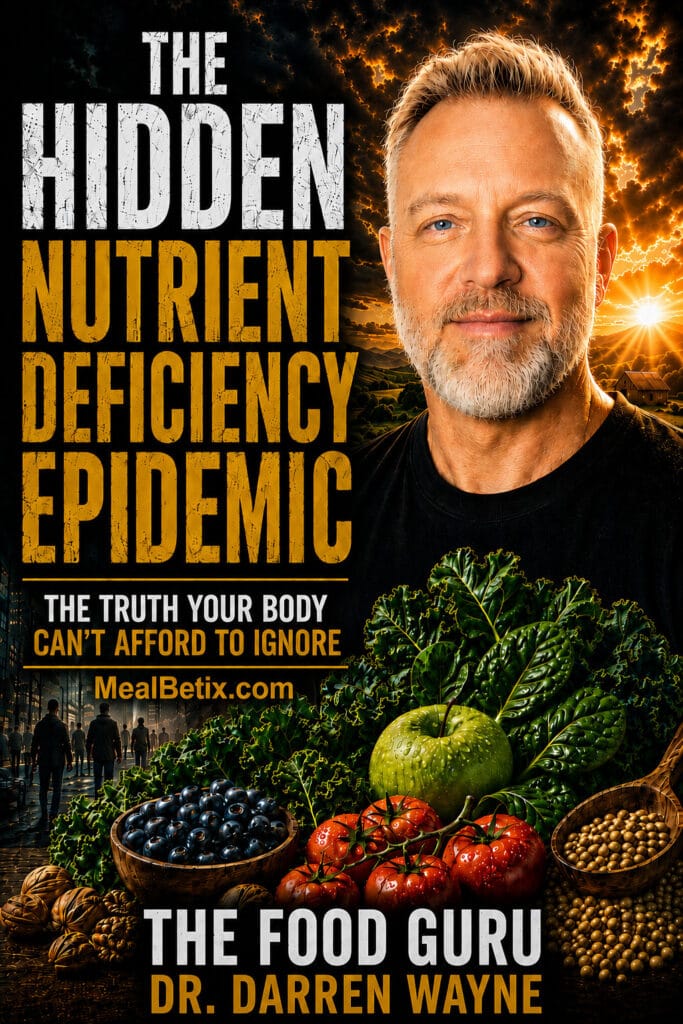
THE HIDDEN NUTRIENT DEFICIENCY EPIDEMIC
The Truth Your Body Cannot Afford to Ignore
TABLE OF CONTENTS
A Personal Letter From THE FOOD GURU
Chapter 1: The Hidden Hunger in Modern Food Starts in the Soil
Chapter 2: The Grocery Store Is Full—So Why Are We Still Starving?
Chapter 3: You’re Not Overeating—You’re Starving: The Hidden Crisis Inside Modern Food
Chapter 4: The Corporate Takeover of the American Dinner Plate
Chapter 5: Tracing the Symptoms and What Your Body Has Been Trying to Tell You
Final Thoughts
About THE FOOD GURU
About MEALBETIX
_______________________________________________
COPYRIGHT PAGE
Copyright © 2026 by THE FOOD GURU – Dr. Darren Wayne
All rights reserved.
No part of this publication may be reproduced, stored in a retrieval system, or transmitted in any form or by any means—including electronic, mechanical, photocopying, recording, or otherwise—without the prior written permission of the publisher, except for brief quotations used in reviews or other uses permitted by applicable copyright law.
This publication is intended for educational and informational purposes only. It reflects the opinions, research, and personal experiences of the author.
The information presented in this book is not intended to diagnose, treat, cure, or prevent any disease and should not be considered a substitute for individualized advice from qualified professionals.
Published by
THE FOOD GURU
MealBetix.com
First Edition
Printed in the United States of America
______________________________________________
DEDICATION PAGE
Dedicated To
Every mother…
Every father…
Every child…
Every family trying to live healthier in a world that has made truly nourishing food very hard to find.
May this book inspire you to ask better questions, demand higher standards, and never settle for “good enough” when it comes to your health.
—THE FOOD GURU
______________________________________________
ABOUT THE FOOD GURU
For decades I have dedicated my life to studying nutrition, food manufacturing, ingredient sourcing, agriculture, and what truly nourishes the human body.
That journey eventually led me to create MEALBETIX®, the last truly clean whole-food meal designed around the principles I believe matter most: ingredient integrity, simplicity, nourishment, and most importantly, truly clean soil and water.
My mission is simple:
Help you think differently about food.
Help you see more what modern food has done to the world.
Help restore confidence that truly clean food still exists and show you exactly where to find it.
Thank you for allowing me to be part of your journey.
—THE FOOD GURU
________________________________
About MEALBETIX®
MEALBETIX was created after years of searching for a truly clean soil and water, and now I grow truly clean food for my family, friends, relatives, and hundreds of families every month –and now for you and your family.
When I couldn’t find one, I decided to build it myself.
Every ingredient was chosen with one goal in mind:
Create food I would proudly serve to my own family.
________________________________
Chapter 1
The Hidden Hunger in Modern Food Starts in the Soil
Our plates may look full, but the deeper question is harder to ignore: how much nourishment is still making it from the soil into the food, and from the food into us?
For most people, malnutrition does not look like an empty plate. It does not announce itself with obvious scarcity or a visible crisis. More often, it hides inside abundance.
It sits in a refrigerator filled with produce, in a pantry lined with options, and in a grocery cart loaded with foods that appear fresh, vibrant, and nourishing. Yet somewhere between the soil and the table, something essential has been diminished, and even completely removed. We may be eating plenty while still falling short on what the body truly needs. And that story begins in the ground beneath us.
Over the last half century, the connection between human health and soil health has been steadily weakened. What earlier generations understood almost instinctively—that strong people depend on strong land—was gradually replaced by an industrial model focused on output, uniformity, speed, and shelf stability.
The central question changed. Instead of asking whether food could deeply nourish a community, the system began asking how efficiently it could produce calories at scale.
That shift changed the quality of the entire food chain.
In the decades after the mid-twentieth century, farming moved toward high-yield production at an unprecedented pace. Crops were increasingly selected for size, visual appeal, transport durability, and consistency in the marketplace.
——— PAGE 1 ———
Success came to mean more volume, fewer variables, and greater efficiency. To support that model, synthetic fertilizers became foundational. Nitrogen, phosphorus, and potassium—NPK—helped drive rapid growth and preserve the appearance of healthy crops. On the surface, it looked like progress. Fields produced more. Produce grew larger. Shelves looked fuller. Stores appeared to offer endless choice.
But abundance and nourishment are not always the same thing.
NPK can stimulate growth, but it does not replace the complexity of living soil. It can help a crop grow, but it cannot rebuild the biological network that helps make food more nutritionally complete. Soil is not lifeless material that can be manipulated artificially.
Soil is a living ecosystem—dense with fungi, bacteria, protozoa, insects, worms, roots, and decomposing organic matter—working together in constant exchange.
In healthy soil, microbes help release minerals from rock and organic matter into forms plants can use. Fungi extend the reach of roots. Bacteria exchange nutrients with plants. Earthworms help create air channels, improve structure, and support water movement.
When that system is thriving, food is not just bigger. It is richer.
When that system is weakened, food can still grow while offering less depth of nourishment.
And for decades, many farming landscapes have been under that pressure. Repeated chemical inputs, monocropping, heavy tillage, pesticide use, and the decline of regenerative practices can reduce microbial diversity and strain the long-term vitality of soil.
Season after season, the Big Food system continues producing crops while giving less back to the ground. The result is a food supply that can still look impressive, yet be increasingly disconnected from the mineral and biological richness that once made it deeply sustaining.
This helps explain why so many people feel unwell in the middle of plenty.
——— PAGE 2 ———
Across modern life, most adults now feel tired, run down, inflamed, swollen, metabolically strained, mentally foggy, or nutritionally unsatisfied even when they are surrounded by food. The standard advice is familiar: eat better, move more, count calories, stay disciplined.
But what if part of the issue runs deeper than willpower or routine? What if many people are trying to build energy, hormones, immune resilience, and mental clarity out of foods that no longer deliver the same nutritional foundation they once did?
The body does not run on calories alone. It mostly depends on raw materials. Minerals are not minor extras added on top of health when convenient.
They help power the systems that keep the body functioning well. Magnesium supports hundreds of enzymatic processes. Zinc plays a role in immune function, repair, and hormone balance. Selenium helps protect cells from oxidative stress. Iron carries oxygen. Calcium contributes to far more than bones alone.
Trace minerals support nerve signaling, blood sugar regulation, thyroid function, energy production, and many of the small but essential processes that keep the body resilient –and none of these vitally important minerals could ever be found in a pill or tablet, only in truly clean food.
When those building blocks are inconsistent, the body adapts as best it can. But adapting is not the same as thriving.
That is one reason someone can eat what appears to be a healthy diet and still feel depleted.
A person may consume salads, smoothies, vegetables, grains, and carefully chosen meals every day, yet still struggle with fatigue, cravings, poor recovery, brain fog, mood swings, or the quiet feeling that something is missing.
It is a lot less often a lack of effort and more often a lack of truly clean nutrition, because the food itself is not delivering enough rea nutrition to fully close the gap.
——— PAGE 3 ———
Comparisons between older food composition records and more recent measurements have repeatedly sparked concern that modern crops now contain dramatically low levels of vitamins and minerals to even nothing, than they once did.
The exact degree varies by crop, region, and farming method, and the data are not always interpreted the same way. Still, the broader concern remains difficult to dismiss: soil degradation is real, and nutrient dilution is a serious issue worth paying attention to.
The emotional weight of that reality is easy to underestimate.
Many families are doing what they have been told to do. They buy produce. They read labels. They try to limit ultra-processed foods. They spend more in an effort to protect their health.
And still, they may watch their energy drop, their focus weaken, their recovery slow, or their loved ones struggle with persistent health issues. It can feel confusing and discouraging. How can a culture surrounded by food still feel so physically underpowered?
Because volume is not the same as nourishment.
Because visual freshness is not the same as biological vitality.
Because a food system can be highly efficient while still leaving important nutritional questions unresolved.
The problem does not stop at the farm. Whatever nutrients remain in modern crops can be affected further by harvesting, storage, transport, processing, and preparation. Produce is often picked before peak ripeness so it can survive long supply chains.
Packaged foods are refined, heated, stabilized, preserved, and reformulated for convenience and shelf life. Flavor is adjusted. Texture is engineered. Longevity is protected. But with each step, foods can move farther from the living complexity they once held.
That leaves modern consumers in a vulnerable position. Many people are trying to build strong health from a food supply that can be inconsistent
——— PAGE 4 ———
while also living in a world that is stressful, fast-moving, polluted, and metabolically demanding.
Under those conditions, it is not surprising that the body sends signals that something is off. Cravings can intensify. Fullness may not feel satisfying. Hunger cues can become confusing.
Recovery can slow. Energy can crash. The body keeps asking for what the food does not always reliably provide.
That is the hidden hunger of the modern age.
It rarely arrives as a dramatic event. It shows up in afternoon crashes, brittle nails, restless sleep, low resilience, and constant dependence on caffeine.
It can appear in the parent who cannot think clearly by evening, the athlete who never feels fully recovered, the child who seems run down too often, or the adult who feels older than they should.
It is subtle enough to be normalized and common enough to be brushed aside. But common is not the same as healthy.
——— PAGE 5 ———
Even if industrial agriculture began shifting course today, restoration would take time. Soil can recover, but not overnight. Rebuilding microbial diversity, organic matter, mineral balance, and regenerative stability is slow work.
It requires different incentives, different practices, different economics, and a very different definition of what success in food production should mean. That shift matters deeply, but it may not happen fast enough for the families trying to nourish themselves right now.
That is where personal responsibility becomes meaningful—not in a blaming sense, but in a practical one. Most people cannot redesign the global food system by themselves.
But they can become more discerning about where nourishment comes from. They can stop assuming that full shelves automatically mean nutritional security. They can recognize that real nourishment should be protected intentionally, not taken for granted.
This is where a completely whole-food, intentionally preserved option can become genuinely valuable. When the mainstream food supply feels inconsistent, diluted, or overly processed, adding a clean source of nutrition like MEALBETIX to a daily routine can create a more dependable foundation. It is not about chasing trends.
It is not about replacing every meal. It is about creating a reliable layer of support in a world where even foods marketed as healthy do not always do all the work on their own.
——— PAGE 6 ———
MEALBETIX offers something many modern diets struggle to deliver consistently: a simple, whole-food way to help close the gap between what the body needs and what the industrial food system does not provide.
In a time shaped by depleted soils, fragile supply chains, and nutritionally depleted groceries, that kind of support is not excessive. It is practical. It is thoughtful. It is a strategic act of care.
Because the deeper problem is not simply that food has changed. It is that people are still expected to function as though nothing has.
The first step toward reclaiming health is telling the truth clearly. The soil has been depleted. Microbial life has been disrupted. Nutrient quality has become nonexistent for most everyone living here. This is our reality.
Food can still look abundant while offering less than many people assume. And the body can feel the difference, even when the reason is not obvious at first.
Once that becomes visible, it changes the way we see nourishment.
And once we understand that the foundation beneath our food has been weakened, the next step becomes clearer: seek foods that are more intentional, more whole, and more capable of supporting the body’s deeper needs. Human health does not ask for perfection.
It asks for building blocks—minerals, cofactors, enzymes, and real nourishment. It asks for the kind of support healthy soil once delivered more reliably.
——— PAGE 7 ———
The hidden hunger is real for many people, but it does not have to stay invisible in daily life. The more honestly we face the decline beneath modern food, the more powerfully we can choose a higher standard for ourselves and the people we care for most.

Now is not the time to leave our health in the hands of modern agriculture, manufacturers and ultra-processed food makers –your health is the most valuable commodity you have, so the more you invest in your food, the more you invest in your health and the more your health keeps providing you the strength you need to live longer.
——— PAGE 8 ———
Chapter 2
The Grocery Store Is Full—So Why Are We Still Starving?
The modern supermarket looks like abundance, but for your body, it is the most convincing form of starvation ever invented.
Step into any supermarket and your senses are instantly overwhelmed. Endless aisles. Towering shelves. Labels screaming natural, healthy, whole grain, fortified, low fat, high protein. Everything is polished, organized, brightly lit, and designed to reassure you that food insecurity is a problem of the past. It feels like victory. It feels like prosperity. It feels like we finally solved hunger.
But your body does not measure food by appearance. Your cells do not care how colorful the packaging is, how long the shelf life lasts, or how beautiful the waxed fruit looks under fluorescent lights. The body measures food by one thing: what it can actually use.
And that is where the illusion begins to collapse.
Because what surrounds us today is not true abundance. It is calorie abundance pretending to be nourishment. It is volume without vitality. It is fuel without repair. It is a factory food system that learned how to mass-produce fullness while quietly starving the human body at the cellular level.
That distinction changes everything.
For the last several decades, industrial agriculture has been praised for efficiency, yield, consistency, and scale. But there has been a hidden price attached to that efficiency, and the price was paid by the soil first.
——— PAGE 9 ———
When land is pushed year after year to produce more, faster, cheaper, and larger crops, while being saturated with synthetic inputs and deprived of natural regeneration, the deep mineral bank of that soil begins to disappear. What once nourished plants from the ground up is gradually stripped away.
And when the soil is depleted, the crops may still grow, but they do not grow with the same intelligence of nature behind them.
They grow faster. They grow larger. They hold more water. They often contain more sugar. They survive shipping. They look good in a photograph. They can sit under bright lights for days or weeks and still appear fresh enough to sell. But beneath that visual perfection, the nutritional architecture is weaker. The density is lower. The complexity is missing.
A tomato can still look like a tomato and yet deliver far less of what your body once received from that same food. A strawberry can taste sweet and still be nutritionally shallow. Spinach can be sold as a symbol of health while carrying only a fraction of the mineral richness that made leafy greens so powerful in the first place.
This is the crisis hiding in plain sight.
People look at their plates and assume they are nourished because they are eating enough. Sometimes more than enough. But enough calories is not the same thing as enough nutrition. That misunderstanding is one of the most devastating mistakes in modern health.
Your body is not simply a machine that burns numbers. It is a living system that requires raw materials to build hormones, repair tissue, regulate the nervous system, produce energy, stabilize mood, balance blood sugar, support detoxification, maintain hydration, and protect itself from inflammation and decay.
Calories can provide energy, yes, but energy without nutrients is like construction workers arriving at a job site with gasoline and no bricks, no wood, no steel, no tools.
So what happens?
——— PAGE 10 ———
Your body adapts the only way it can.
It slows down. It becomes conservative. It reads the environment as unreliable. Even while calories are pouring in, your biology detects the absence of key minerals, vitamins, antioxidants, phytonutrients, enzymes, and cofactors. And when the body senses that it is not receiving what it needs to maintain itself, it does not respond with trust. It responds with stress.
This is why so many people are trapped in a painful paradox: overfed, yet undernourished. Full, yet still craving. Eating constantly, yet somehow running on empty.
You have likely felt this yourself.
You eat a meal that should have been enough. Plenty of calories. Plenty of flavor. Maybe even plenty of protein on paper. But an hour later, the hunger returns. Not always as a growling stomach. Sometimes it arrives as irritability. Sometimes as fatigue.
Sometimes as a sweet craving you cannot explain. Sometimes as that restless sensation that makes you open cabinets, scan the fridge, and keep searching for something that will finally make your body settle down.
That is not a moral failure. That is not a lack of discipline. In many cases, that is your biology asking for what the meal never delivered.
When magnesium is low, when potassium is low, when trace minerals are low, when plant compounds are missing, the body continues sending signals.
It keeps asking. It keeps pushing. More food, more food, more food, because somewhere inside its ancient survival intelligence it is trying to locate the missing pieces.
But in a food environment dominated by refined oils, processed grains, isolated sugars, synthetic additives, and chemically altered convenience foods, the search becomes endless.
——— PAGE 11 ———
The body asks for nourishment and gets handed stimulation. It asks for repair materials and gets quick-burning fuel. It asks for life and gets shelf-stable imitation.
This is why calorie counting, by itself, is such an incomplete strategy.
If the body were a simple math equation, then two hundred calories of one food would behave exactly like two hundred calories of another. But that is not how life works.
A body starved of nutrient density does not relax just because it hit a number. It does not suddenly stop sounding alarms because an app says the daily goal has been met.
The body is always asking a deeper question: Did you give me what I need to survive, repair, and thrive?
If the answer is no, then stress remains high. Cravings remain high. Energy output may drop. Fat storage becomes easier. Recovery becomes harder. Inflammation lingers. Mood gets fragile.
Sleep suffers. Digestion slows. And people blame themselves for what is, in many cases, a biological response to nutritional emptiness.
That is the tragedy of this modern illusion. We are living in a world where food is everywhere, yet true nourishment is increasingly rare.
And nowhere is that illusion more dangerous than for families.
Parents walk through stores trying to make responsible choices. They want convenience because life is busy. They want affordability because budgets are real.
They want foods that children will actually eat. They want labels they can trust. But the system has become so sophisticated at disguising depletion that even well-meaning choices can still produce exhaustion, behavioral swings, chronic snacking, poor focus, sluggish digestion, and gradual weight gain.
——— PAGE 12 ———
Because the issue is not only what is absent from junk food. It is what is absent from much of the entire food landscape.
Once you understand that, your standards change.
You stop asking only, How many calories is this?
You start asking, What is this actually made of? What did this grow in? How heavily was it processed? How much of its original life force remains? Will this feed my cells or merely occupy my stomach?
That is a profound shift, because it moves you away from managing symptoms and toward correcting inputs.
The goal is no longer to just eat less. The goal is to eat cleaner, deeper, and smarter. To prioritize foods that carry genuine biochemical value. To seek out ingredients that still resemble nature.
To reduce the burden on digestion instead of overwhelming it with heaviness, additives, and empty density. To give the body what it has been begging for rather than silencing it with another wave of artificial fullness.
And this is exactly why truly clean solutions matter.
When your life is busy, the answer cannot simply be to spend every day hunting farms, reading research, and preparing every meal from scratch with perfect ingredients. People need realistic tools. Families need support. Health has to be made practical, not just idealistic.
That is where a clean whole-food becomes more than convenience. It becomes protection.
In a food environment built on illusion, MEALBETIX offers something radically different: simplicity with integrity. Instead of forcing your body to process heavy, low-quality, chemically manipulated calories that leave you drained, foggy, and unsatisfied, it gives your body a cleaner stream of nourishment it can actually recognize and use.
That matters more than most people realize.
——— PAGE 13 ———
When the digestive system is overloaded with processed and refined ingredients, it spends enormous energy trying to break down substances that were never designed to support life.
That burden can leave you feeling sluggish after eating, mentally dull, and still somehow unsatisfied. But when a meal is truly clean, the experience is different. Energy feels steadier.
Your body feels less burdened. Hunger becomes calmer. Cravings become less chaotic. You begin to notice what real nourishment feels like.
And once you feel that contrast, the old food system loses much of its power over you.
Because the truth is, your body knows the difference.
It knows the difference between being stuffed and being fed.
It knows the difference between chemical calories and whole-food nourishment.
It knows the difference between an eating pattern that creates inflammation and one that creates stability.
And when you finally begin giving your body cleaner, denser, more honest nutrition, it often responds with relief before it responds with transformation. Relief in digestion. Relief in mood. Relief in cravings. Relief in mental clarity. Relief in that constant internal noise that has been telling you to keep reaching for more.
This chapter is not about fear. It is about awakening. It is about learning to see through the disguise.
The supermarket may still look abundant. The shelves may still overflow. The marketing may still be beautiful. But health begins when you stop confusing access with nourishment.
In this era, protecting yourself and the people you love means becoming far more discerning about what counts as food. It means choosing purity over packaging, density over volume, and function over fantasy. It means
——— PAGE 14 ———
refusing to let your family be trapped on the treadmill of empty calories and constant hunger.
The illusion of abundance is powerful, but it is not unbeatable.
The moment you understand that fullness is not nourishment, you take your power back.
 And the moment you begin replacing empty calories with clean, whole-food support like MEALBETIX, you are no longer feeding the illusion. You are feeding life.
That is how the cycle begins to break.
That is how the body begins to trust again.
And that is how real nourishment returns to your meals.
We are surrounded by calories, yet starving for real nutrition.
——— PAGE 15 ———
Chapter 3
You’re Not Overeating—You’re Starving: The Hidden Crisis Inside Modern Food
You can be full every day and still be starving at the cellular level.
Let that sink in, because it explains why so many people are exhausted, swollen, anxious, foggy, and frustrated even while eating three meals a day, snacks in between, and more ‘food’ than any generation before them.
We are living through one of the strangest health crises in human history: an overfed world suffering from chronic starvation.
And no, I am not talking about the kind of starvation most people imagine. I’m talking about chronic starvation, the silent breakdown that happens when the body gets plenty of fuel but almost none of the raw materials it actually needs to repair, regulate, and thrive.
This is the tragedy of modern eating. Your stomach may be full, your pantry may be packed, your grocery cart may overflow, and your family may never miss a meal.
But if the minerals, trace elements, enzymes, phytonutrients, and life force of real food are missing, your cells are still operating like a city under rationing.
That is why so many people wake up tired after a full night’s sleep. That is why the afternoon crash feels normal. That is why brain fog gets blamed on age, brittle nails get blamed on stress, thinning hair gets blamed on hormones, poor focus gets blamed on a busy life, and low resilience gets blamed on getting older.
But your body is not confused. Your body is signaling distress.
——— PAGE 16 ———
Here’s the deeper issue: food is only as nourishing as the soil it comes from and of course what happens to it before it gets to your kitchen. And the soil beneath modern agriculture has been stripped, depleted, and exhausted by decades of industrial farming, at least a century of spraying, monocropping, and aggressive production methods that prioritize volume over vitality. We learned how to grow bigger more resilient harvests, but sacrificed quality for quantity.
We did not protect the mineral intelligence of the earth those harvests depend on.
So now we have shelves full of ‘food’ that look normal, taste acceptable, and deliver calories, but fail to deliver complete nourishment.
The produce may still be colorful. The labels may still say natural. The packaging may still promise health. But at the cellular level, a lot of people are running on fumes, even running on empty.
And when the body runs low on key nutrients, everything becomes more expensive internally. Enzymes cannot do their work efficiently without mineral cofactors. Hormones cannot be made and balanced properly without the right building blocks.
——— PAGE 17 ———
Neurotransmitters that influence mood, sleep, focus, and emotional steadiness suffer. Detox pathways slow down. Repair slows down. Recovery slows down. Even your ability to make energy starts to falter.
So what does that look like in real life?
It looks like needing caffeine just to get through the day.
It looks like cravings that never go away, because the body keeps asking for what it still hasn’t received.
It looks like eating enough, sometimes too much, and still feeling unsatisfied.
It looks like a child who cannot focus, a mother who feels depleted, a father who feels older than he is, and a household that assumes this is just what modern life feels like.
But it is not normal. It is common. But common is not the same as normal.
The most heartbreaking part is that people are often blamed for symptoms that are really biochemical cries for help. They are told they lack discipline, need more willpower, should just sleep better, should push harder, should accept aging, or should start another prescription.
Meanwhile, the deeper question goes unasked: what if the body is not failing from weakness, but from deficiency?
You cannot build vibrant health out of emptiness.
——— PAGE 18 ———
If your thyroid does not have adequate selenium and iodine, it cannot function with excellence. If your muscles and nervous system are starved of highly bioavailable magnesium, tension, fatigue, poor sleep, and stress sensitivity can become your daily baseline.
If the body lacks zinc, copper, B vitamins, and trace minerals, the systems that govern immunity, hormones, skin integrity, cognition, and cellular repair begin to lose precision.
And this is where modern medicine always misses the plot. It chases symptoms downstream instead of asking what has been missing upstream for years.
One pill for sleep. One pill for mood. One pill for inflammation. One pill for energy. One pill for digestion. One pill for blood pressure. One pill for focus. Yet the body is still undernourished and is now even more depleted from all those pills.
Let me say this as clearly as possible: you cannot medicate your way out of a soil deficiency.
A synthetic chemical may suppress a symptom. It may alter a pathway. It may force a temporary response. But it cannot replace the deep biological intelligence of real nutrition arriving in a form the body recognizes, absorbs, and uses.
The human body was not designed to live on isolated compounds and calorie-dense emptiness. It was designed to draw life from living food. Food that carries complexity. Food that carries synergy. Food that contains not just one celebrated nutrient on a label, but the orchestra of elements that allow healing to happen in harmony.
——— PAGE 19 ———
That synergy matters more than most people realize. Nutrients do not operate alone. They work in relationship. They depend on one another. Remove the mineral matrix, and the music of metabolism starts falling apart.
That is why so many people can eat more and more, supplement daily, and still never quite feel restored. The body does not just need more intake. It needs real truly clean usable nourishment.
This is why the phrase empty calories is too soft for what is happening. What we are seeing is nutritional erosion on a massive scale. A slow cellular famine hidden beneath abundance. A nation of people who appear fed, yet whose internal reserves are collapsing quietly over time.
And when reserves collapse, resilience goes with them.
Stress hits harder. Recovery takes longer. Mood becomes less stable. Sleep becomes more fragile. Focus becomes more difficult. Immunity becomes more reactive or weaker. Skin loses radiance. Hair loses strength. Joints lose comfort. Motivation disappears. Life starts to feel heavier than it should.
People think this is just adulthood or the price of getting older.
It is not.
It is often the cost of long-term depletion.
Now here is the hopeful part: your body is incredibly wise, and when given what it has been missing, it has a remarkable capacity to recover, rebalance, and come alive again.
That recovery does not begin with another trendy snack, another fortified cereal, another low-fat processed product pretending to be healthy, or another lab-made shortcut. It begins by reintroducing dense, clean, concentrated nutrition that honors the body’s original design.
——— PAGE 20 ———
That is exactly why MEALBETIX matters.
MEALBETIX is not trying to play the same game as the modern grocery store. It is not another processed compromise dressed up in health language. It is not another synthetic patch meant to imitate vitality while bypassing nature.
It is a strategic return to what the body has needed all along: real, raw, living nutrition delivered in a form that helps close the gap created by decades of agricultural depletion.
In a food system where appearance often replaces substance, MEALBETIX gives substance back. It delivers a dense infusion of the vital elements modern soil no longer reliably provides. It helps nourish the terrain beneath your energy, clarity, immune strength, metabolic balance, and recovery. It supports the foundations instead of distracting you with surface-level promises.
And that matters, because true health is not built by managing dysfunction forever. True health is built by removing obstacles and supplying the body with what it needs to perform its own intelligent repair.
Imagine what changes when your cells are no longer scraping by.
Imagine waking up with steadier energy.
Imagine a mind that feels clearer by midmorning instead of foggier.
Imagine sleep that actually restores you.
——— PAGE 21 ———
Imagine fewer cravings, better stress tolerance, stronger nails, healthier-looking hair, more stable moods, and an immune system that does not feel so fragile.
That is not fantasy. That is what becomes possible when the body is no longer trapped in a cycle of hidden deprivation.
This is bigger than individual wellness. It is about families. It is about children developing on nutrient-poor food. It is about parents trying to lead households while depleted. It is about communities accepting fatigue and dysfunction as normal because almost everyone they know feels the same way.
We have normalized symptoms that should have warned us.
We have normalized surviving instead of thriving.
We have normalized feeding people without truly nourishing them.
But you do not have to stay trapped in that system.
You can choose to become intentional. You can stop assuming calories equal nourishment. You can stop outsourcing your health to symptom management alone. You can start rebuilding from the cellular level, where real vitality begins.
——— PAGE 22 ———
Because the truth is simple: if the soil is weak, the food is weaker. If the food is weaker, the body pays the price. And if the body has been paying that price for years, the solution is not to ignore the bill. The solution is to restore what has been missing.
That is the role MEALBETIX can play in your health strategy. Not as a magic bullet. Not as a gimmick. But as a clean, deliberate, powerful source of living nutrition in a world that desperately needs it.
 If you have been feeling like your body is asking for something more, listen to that signal. If you have been doing everything you were told and still do not feel vibrant, do not dismiss that experience. If your family deserves better than modern food’s slow starvation, then act like it.
Choose nourishment with intelligence. Choose food that gives life back. Choose a strategy that supports your cells, not just your schedule.
And if you are ready to stop being overfed and undernourished, make MEALBETIX part of the way forward. Your body has been speaking for a long time. This is the moment to answer it.
——— PAGE 23 ———
Chapter 4
The Corporate Takeover of the American Dinner Plate
What happened to our food was not an accident—it was a hostile takeover.
For most of human history, food was grown in relationship with the land. A farm was not a spreadsheet. It was an ecosystem. It was a living cycle of soil, rainfall, livestock, seasons, compost, patience, and stewardship.
Families who worked that land understood a truth that modern industrial agriculture has tried to erase: when you care for the soil, the soil cares for you.
The food that rises from healthy ground carries structure, vitality, and the deep biological intelligence that nourishes the human body at the cellular level.
Over the last half century, that relationship has been systematically dismantled. The American dinner plate did not simply change because consumer preferences evolved or because technology made farming easier. It changed because control changed hands.
The center of gravity moved away from independent growers and toward large corporations whose first loyalty is not nourishment, not land regeneration, and certainly not public health. Their loyalty is to scale, efficiency, uniformity, and quarterly returns.
——— PAGE 24 ———
That shift matters more than most people realize. Once agriculture became governed by corporate logic, food stopped being treated as a sacred necessity and started being treated as an industrial output.
The objective was no longer to produce the most nutrient-dense, biologically vibrant food possible.
The objective became producing the highest volume of sellable material at the lowest cost, with the least disruption to transportation, storage, processing, and profit margins.
This is the root of the hollowing out. And if you do not understand this chapter of the story, you will never fully understand why so much of what fills modern grocery stores looks like food, tastes like a weaker version of food, and yet leaves the body undernourished.
The traditional diversified family farm operated on principles that now sound almost radical. Farmers rotated crops. Animals grazed on pasture and returned fertility to the land through manure. Fields were allowed periods of rest.
Different plant species shared the same environment, each contributing to a balanced biological web above and below the surface. This diversity protected the soil. It supported microbial life. It reduced pest pressure naturally. It created resilience.
——— PAGE 25 ———
Corporate agriculture rejected that model because diversity is harder to scale. It is harder to mechanize. It is harder to standardize. So the landscape was simplified into monoculture: vast acres of the same crop planted over and over again, season after season. Corn. Soy. Wheat. Cotton. Repeat. From a financial perspective, monoculture is efficient. From a biological perspective, it is devastating.
A single crop grown continuously extracts a narrow band of nutrients from the soil again and again. It invites specific pests to multiply because their preferred food source is always present.
It strips away the ecological complexity that once kept disease, insects, and weeds in natural balance. The soil becomes progressively weaker, less alive, less structured, and less capable of supporting nutrient-rich crops on its own.
Healthy soil is not just dirt. It is a living matrix filled with bacteria, fungi, minerals, organic matter, moisture channels, root exudates, and microscopic cooperation.
When that living system is damaged, the food grown in it changes. It may still reach full size. It may still look attractive under supermarket lighting. But appearance is not vitality. Mass is not nourishment.
This is where the industrial illusion becomes dangerous. Corporate farming can produce abundance in terms of volume while simultaneously producing deficiency in terms of nutrition.
A tomato can be red and round yet less complex than the tomato your grandparents ate. Spinach can be bundled, boxed, and shipped nationwide while carrying less of the mineral depth once found in naturally fertile soils. Calories remain available. Biological value declines.
——— PAGE 26 ———
As soil quality deteriorated, industrial agriculture did not respond by restoring the land. It responded by replacing biology with chemistry. Instead of asking how to regenerate fertility, the system asked how to force production from exhausted ground.
Synthetic fertilizers delivered isolated nutrients directly to crops, mostly emphasizing nitrogen, phosphorus, and potassium. Herbicides were used to kill competing plants.
Pesticides were applied to suppress the ecological imbalances monoculture created. Fungicides, growth regulators, seed coatings, and proprietary chemical programs became standard operating procedure.
This approach can keep yields moving, but it does not rebuild life in the soil. In many cases, it further degrades it. The result is a farming model that becomes increasingly dependent on external inputs just to maintain output.
The land is no longer functioning as a living foundation. It is functioning as a production platform that must be chemically managed into compliance.
And then there is the food itself. Once corporations took command of the supply chain, they also dictated which traits were desirable in crops. But the desired traits were not selected for your health.
They were selected for industrial convenience. Produce needed to survive mechanical harvesting, long-distance shipping, cold storage, warehouse handling, retail display, and extended shelf time.
——— PAGE 27 ———
That meant tougher skins, more uniform sizing, controlled ripening, visual consistency, and durability under transport stress.
Think about what gets lost in that equation. Fragility. Aroma. Peak ripeness. Mineral density. Flavor complexity. Wild variation. Those are often the exact traits associated with truly alive food, and they are the exact traits that make industrial logistics more difficult. So they were deprioritized.
This is why so many people sense that modern produce is missing something, even if they cannot articulate it. It is not nostalgia. It is not imagination.
It is the lived experience of biological dilution. Food has been optimized for storage and transport so aggressively that nutritional and sensory integrity have often become secondary concerns.
The same pattern shows up in animal agriculture. When animals are raised in confinement rather than on pasture, fed monotonous diets rather than natural ones, and managed for accelerated weight gain rather than biological health, the quality of the food they produce changes too.
The system is built around throughput. Faster growth. Faster turnover. More units moved. Less room for natural rhythms. Again, the metric is efficiency, not nourishment.
——— PAGE 28 ———
At every stage, the corporate food model asks the same question: how do we move more product more cheaply? It rarely asks the question that matters most to families: what kind of food best supports human health over a lifetime?
That is the question we have to bring back to the center.
Because once you see the system clearly, you stop expecting it to protect you. You stop assuming that something sold everywhere must also be wholesome. You stop confusing convenience with safety or abundance with nourishment.
And you begin to understand why reclaiming your health requires more than reading a label. It requires stepping outside a supply chain that was never designed with your cellular integrity in mind.
Food sovereignty begins with discernment. It means recognizing that the industrial food system is structurally incentivized to cut corners that you may never see.
It means understanding that a product can be profitable, legal, beautifully packaged, and still disconnected from the standards your body actually needs. It means becoming willing to ask harder questions about sourcing, farming methods, ingredient integrity, and processing.
This is not about perfection. It is about direction. Every step away from degraded, industrialized food and toward clean, whole, genuinely nourishing meals is a step toward restoring the body’s internal environment.
——— PAGE 29 ———
When you choose food rooted in quality rather than convenience, you reduce the burden on your system. You stop flooding the body with compromised inputs and start providing the raw material it can actually use.
That is why solutions outside the corporate machine matter so deeply right now. Families are overwhelmed, busy, and often caught between knowing better and having limited time.
The answer cannot simply be guilt. It has to be access. It has to be practical. It has to make it possible for people to eat in a way that aligns with their values and protects their health without forcing them to become full-time food investigators.
This is where MEALBETIX becomes more than a product. It becomes a line in the sand. A refusal to accept the false choice between convenience and integrity.
A commitment to bringing back meals that are clean, uncompromised, and deeply nourishing in a world that has normalized the opposite.
When a meal solution is built outside the industrialized agricultural mindset, it creates a powerful alternative for households that want real support instead of more chemically burdened, nutrient-weakened food.
MEALBETIX stands apart because it reflects a different philosophy from the ground up. Not extraction, but nourishment. Not industrial compromise, but purity.
——— PAGE 30 ———
Not corporate standardization, but authentic food that honors what the human body actually requires. In a landscape flooded with empty convenience, that distinction is profound.
Reclaiming the American dinner plate will not happen through better marketing from the same broken system. It will happen when enough people decide that their health is too sacred to outsource to corporations that treat food as a commodity first and nourishment as an afterthought.
 It will happen when we remember that the quality of what we eat shapes the quality of our blood, our energy, our resilience, our immunity, and our future.
The corporate takeover of food was deliberate. Your response must be deliberate too. Choose meals that restore, not deplete. Choose sources that respect life, not just logistics.
Choose nourishment that strengthens your foundation instead of eroding it. And if you are ready to step away from the industrial food chain and put real power back in your body, MEALBETIX offers a clean and practical path forward—one meal, one decision, and one reclaimed standard of health at a time.
——— PAGE 31 ———
Chapter 5
Tracing the Symptoms And What Your Body Has Been Trying to Tell You
Your symptoms are not betraying you—they are reporting a nutrient emergency.
For decades, people have been taught to distrust their own bodies. We are conditioned to see fatigue as laziness, cravings as weakness, headaches as inconvenience, and poor sleep as something to push through.
But the body does not create symptoms for entertainment. It creates symptoms for survival. Every signal has meaning. Every ache, crash, flutter, and foggy moment is part of a communication system designed to keep you alive.
When we ignore those messages long enough, or worse when you numb the discomfort with pharmaceuticals, the warning signs get louder.
That afternoon energy collapse that sends you looking for coffee or sugar is not just a normal part of adult life.
The muscle tightness in your shoulders, the heaviness in your legs at night, the headaches that keep returning, the dry skin that no lotion seems to fix, the hair that looks thinner than it used to, the brittle nails, the brain fog, the irritability, the weak stress tolerance—these are not isolated inconveniences.
They are often linked by one common root: deficiency.
——— PAGE 32 ———
And deficiency today is no minor issue.
The nutritional value of food has changed because the soil has changed. When the ground is depleted, crops are depleted. When crops are depleted, people become depleted—slowly, silently, and systemically.
You may be eating enough calories and still be starving at the cellular level. That is one of the greatest nutrition traps of modern life: full stomach, empty cells.
Your body knows the difference.
It knows when magnesium is too low to support calm nerves and relaxed muscles. It knows when zinc is too scarce to sustain immune defenses, skin repair, and hormonal balance.
It knows when iron is too limited to transport oxygen efficiently through the bloodstream. It knows when trace minerals are missing from the chemical orchestra that powers energy production, detoxification, tissue repair, and mental clarity.
The body always prioritizes survival first.
If minerals and vital nutrients are limited, your system enters a kind of internal rationing program. It starts sending the best of what it has to the most essential operations: heartbeat, breathing, blood pressure regulation, and emergency metabolic function. That sounds smart, and it is.
——— PAGE 33 ———
But there is a cost. When your body is stuck in long-term rationing mode, there is less available for the functions that make you feel vibrant, sharp, lean, resilient, calm, and strong.
That is why deficiency often shows up first in quality-of-life symptoms before it becomes a diagnosed crisis.
Sleep becomes lighter. Stress hits harder. Recovery slows down. The immune system gets inconsistent. Digestion becomes more sensitive. Mood becomes less stable.
Concentration fades faster. Joints feel older. Skin loses its glow. Exercise drains you more than it should. The body is still functioning, but no longer thriving.
This is where many people make the wrong turn.
Instead of asking, What is my body missing, they ask, What can I take to silence this symptom? So they drink another stimulant, use another pain reliever, add another quick-fix product, or normalize another layer of discomfort.
But numbing a signal does not solve the shortage that created it. In many cases, it delays the real solution.
Let us trace how this unfolds.
One of the earliest and most common areas affected by mineral depletion is the nervous system. Magnesium, in particular, plays a central role in relaxation, electrical signaling, muscle function, and stress response.
——— PAGE 34 ———
When magnesium runs low, the body often becomes more reactive. You may feel tense for no clear reason.
Sleep may be harder to initiate and easier to interrupt. Muscles may twitch, tighten, or cramp. Restless legs may show up at night. Patience gets shorter. Recovery from emotional stress takes longer. Many people think they have simply become anxious, but in reality their physiology is struggling to calm itself.
Then there is energy.
Low iron, low magnesium, and inadequate trace minerals can contribute to a body that feels underpowered. Not lazy—underpowered. There is a difference. You may wake up tired even after a full night in bed.
You may feel decent in the morning and then crash by midafternoon.
Workouts may feel heavier. Stairs may feel steeper. Motivation may drop not because your character failed, but because your cells are not getting what they need to produce energy efficiently.
The immune system also pays a price when nutrient density disappears from daily food. Zinc is one of the key minerals involved in immune resilience, tissue healing, and protection against everyday biological stress.
When zinc status is weak, people often notice that they catch things more easily, take longer to recover, or seem to operate with a constant low-grade vulnerability. Their body is trying to defend, repair, and recover with an empty toolbox.
——— PAGE 35 ———
Skin, hair, and nails tell another part of the story.
These may seem cosmetic, but they are often diagnostic messengers. Dry skin can suggest fatty acid imbalance, dehydration, or mineral shortage. Ridges in the nails can reflect poor nourishment over time.
Thinning hair can be associated with stress, hormonal disruption, low iron, low zinc, and inadequate overall nutrient availability. The body is practical.
If supplies are limited, it does not prioritize luxurious hair growth or glowing skin. It uses what it has to protect organs and preserve life.
This is why appearances can change when internal nourishment drops.
Digestion is another major clue. A depleted body does not digest, absorb, and eliminate with full efficiency. Enzyme activity, gut lining repair, stomach acid production, and microbiome balance all depend on nourishment.
If you are bloated, irregular, sluggish after meals, or strangely unsatisfied no matter how much you eat, the issue may not simply be food quantity. It may be food quality and nutrient completeness.
Cravings fit this pattern too.
People often blame themselves for wanting sugar, salt, or constant snacks, but cravings can be the body’s attempt to chase what it is not receiving. When meals are calorically dense but nutritionally thin, satisfaction stays low.
The body keeps asking for more because, from its perspective, more volume might finally deliver the missing pieces. This is how overfed and undernourished can exist at the same time.
——— PAGE 36 ———
Mental performance also declines when minerals disappear from the daily plate.
The brain depends on a constant supply of nutrients to produce neurotransmitters, regulate inflammation, stabilize mood, and maintain focus.
Deficiency can feel like forgetfulness, low drive, poor concentration, mental fatigue, or emotional fragility. People may think they are losing discipline when they are actually losing nutritive support.
And over time, the cumulative burden becomes deeper.
When deficiency persists for months or years, the body adapts downward. Metabolism slows. Repair becomes less efficient. Inflammation lingers longer. Stress tolerance narrows.
Hormonal balance becomes more difficult. What began as small warning signs can develop into broad patterns of dysfunction. This is not because the body is weak. It is because the body has been asked to perform miracles with inadequate raw materials.
That is why listening matters.
Listening to your body does not mean obsessing over every sensation. It means respecting symptoms as data instead of dismissing them as background noise.
——— PAGE 37 ———
It means understanding that chronic fatigue, recurring tension, poor sleep, brittle nails, dull skin, weak recovery, and frequent illness are not random badges of modern adulthood. They are messages.
And if the message is deficiency, the answer is not another patch.
The answer is replenishment.
Real replenishment starts with a serious upgrade in food quality. Not prettier packaging. Not louder health claims. Not another artificial product pretending to be nutrition. The body needs clean, complete, bioavailable nourishment from whole-food sources that still carry the spectrum of living compounds nature intended.
This is exactly why MEALBETIX matters.
When your system has been running on nutritionally compromised foods, it does not need more empty calories. It needs density. It needs purity.
It needs broad-spectrum nourishment that helps close the gap modern agriculture has opened. Making MEALBETIX part of your daily routine gives your body a practical, consistent source of clean whole-food nutrition designed to support what ordinary meals increasingly fail to provide.
That support is not theoretical. It is functional.
——— PAGE 38 ———
It helps feed the mineral hunger behind stress sensitivity, sluggishness, weak recovery, and chronic low-level depletion. It helps restore the nutritional foundation your body relies on for energy production, tissue repair, immune support, and metabolic resilience. It helps move you away from emergency rationing mode and closer to the state your body has been asking for all along: enough.
Enough nourishment to sleep more deeply.
Enough support to recover more smoothly.
Enough mineral density to help calm the nervous system.
Enough nutritional completeness to stop chasing satisfaction through endless snacking and stimulants.
Enough real food power to help your body do what it was designed to do.
Because true health does not begin when symptoms are silenced.
It begins when the cause is addressed.
So if your body has been whispering through fatigue, speaking through cravings, or shouting through pain, do not treat that as bad luck. Treat it as guidance. The signals are not your enemy. They are your evidence.
Your body is showing you where support is missing.
——— PAGE 39 ———
The question is whether you will keep muting the alarm, or finally answer it.
Choose nourishment that works with the body instead of against it. Choose food that replenishes instead of merely fills. Choose a daily solution that helps restore what modern nutrition has lost.
Make MEALBETIX a cornerstone of your routine, and give your body what it has been asking for—clean, complete, unpolluted nourishment that reaches deeper than quick fixes ever can.
When deficiency is finally addressed at the root, your body responds with something powerful and unmistakable: relief, resilience, and the return of real vitality. I hope your eyes have been opened and you are now ready to take back your food –and your health!
Ask me a question anytime at ask@mealbetix.com
#MealBetix #TheFoodGuru #NutrientDeficiency #MineralDeficiency #WholeFoodNutrition #HealthEducation #BioavailableNutrition #DeadSoil #ModernNutrition #EnergySupport #ImmuneHealth #BetterSleep
nutrient deficiency symptoms, mineral deficiency signs, dead soil nutrition, whole food nutrition, magnesium deficiency symptoms, metabolic slowdown, clean nutrition, MealBetix, deficiency and symptoms, modern food depletion.

Look for other eBooks by THE FOOD GURU coming soon
- 100 Toxic Ingredients You Should Never Eat
- The Glyphosate Challenge
- Read Food Labels Like a Nutrition Expert
- The Ingredient Blacklist
- The Ultra-Processed Food Deception
- The Corporate Takeover of the American Dinner Plate
- What Your Grocery Store Doesn’t Want You to Know
——— PAGE 40 ———